There are two students in my current divemaster class. They are naturals in the pools and it has been a lot of fun working with them on the various skills that we have cover. Last night, I sprang a surprise on them. I have a non-diving friend who was visiting me and I suggested to him that he accompanies me to class and be a discover scuba student for the evening.
The two candidate divemasters had to walk my friend though all the steps of setting up the gear. He didn't have to set up any of the gear himself, but just had to watch and learn. The candidates did a fantastic job. One of the candidates has a great way of explaining concepts in every day terms and makes even seemingly complex things seem easy and understandable. They seemed to really enjoy the unexpected challenge.
The advantage that I could see was that they had an actual person to demonstrate the skill to which probably made it more realistic for them. In any event, they will make excellent instructors one day.
Tuesday, October 03, 2006


Friday, September 29, 2006
Caught rather than taught?
There are two course directors that teach at the same store as I do. The senior of the two course directors has been teaching for many years and has encyclopedic knowledge of dive theory, local dive sites, people in the industry etc. He is really one of a kind. However, the senior course director (SCD) has not taught confined water skills in any of the classes that I have attended so far. The two course directors divided up the work and each chose to teach a different component of the IDC (instructor development course).
The course director that taught me most of what I know about instructing is excellent and I have written previously about how I still feel like a student around him. However with SCD, I have not really built up that kind of relationship and was a little curious about what his teaching skills would be like in the pool.
In the current IDC that is being held, SCD is the only course director since the other CD has work commitments that prevented him from attending. So last week, I got to work with SCD in the pool and I must say I enjoyed the experience. His style is unique to him of course (like everyone), but I both found that I learned some new ways of explaining the same skills and also found that I found his style familiar. By being familiar, I mean that I could identify with how he was conducting the class and found that even though we were taught by different people in different generations, there were enough similarities that I felt that we were on the same page every step of the way.
The casual observer might say that since we are both certified by the same agency one could suspect or expect that we would be on the same page. But I would counter that although we are expected to perform up to the same minimum certification, there is a huge component of "stuff" that is only "caught" rather than "taught". This intangible quality could variously be referred to as culture, oral learning, affective behavior, etc. I am not a trained educator, but I know that in any organization there are written and unwritten rules, procedures and methods. The same could be said of how one conducts SCUBA instruction.
Sometimes as instructors we convey just as much by our behavior, dress, demeanor, enthusiasm, professionalism, patience, etc. as we do by the actual content of the lectures. This is obvious stuff really, but as instructors we need to always pay attention to the intangible aspects of working with students - for example by trying to get them to be as passionate as we are about diving. (ok - I made a big assumption about passion here, but I sincerely hope that each and every instructor is passionate about diving and has not lost the fire and passion for diving.)
The course director that taught me most of what I know about instructing is excellent and I have written previously about how I still feel like a student around him. However with SCD, I have not really built up that kind of relationship and was a little curious about what his teaching skills would be like in the pool.
In the current IDC that is being held, SCD is the only course director since the other CD has work commitments that prevented him from attending. So last week, I got to work with SCD in the pool and I must say I enjoyed the experience. His style is unique to him of course (like everyone), but I both found that I learned some new ways of explaining the same skills and also found that I found his style familiar. By being familiar, I mean that I could identify with how he was conducting the class and found that even though we were taught by different people in different generations, there were enough similarities that I felt that we were on the same page every step of the way.
The casual observer might say that since we are both certified by the same agency one could suspect or expect that we would be on the same page. But I would counter that although we are expected to perform up to the same minimum certification, there is a huge component of "stuff" that is only "caught" rather than "taught". This intangible quality could variously be referred to as culture, oral learning, affective behavior, etc. I am not a trained educator, but I know that in any organization there are written and unwritten rules, procedures and methods. The same could be said of how one conducts SCUBA instruction.
Sometimes as instructors we convey just as much by our behavior, dress, demeanor, enthusiasm, professionalism, patience, etc. as we do by the actual content of the lectures. This is obvious stuff really, but as instructors we need to always pay attention to the intangible aspects of working with students - for example by trying to get them to be as passionate as we are about diving. (ok - I made a big assumption about passion here, but I sincerely hope that each and every instructor is passionate about diving and has not lost the fire and passion for diving.)
Friday, September 15, 2006
The small things matter too
This coming weekend, my diving buddy and I are going to be teaching an advanced open water class. The class consists of some classroom presentations, and two days of diving. There are two required components - navigation and deep. The other three components are up to the discretion of the instructor. However at the local dive store (LDS) that I teach at, we all teach the same optional components for the advanced class. The advantage is that everyone is on the same page and it makes logistics etc. easier.
One of the modules that we will be teaching this weekend is naturalist. The aim of this component is to expose the students to the various types of animals and plants they might encounter in the various types of diving they will be doing in the future. From my own perspective, I can attest to the fact that I have enjoyed my diving a lot more since I have started to pay a lot more attention to the various species of plants and animals on dives.
My diving buddy, the navigating phenom (NP) is an avid photographer and videographer. He has a keen eye for detail and manages to get spectacular shots on just about every dive. The secret is that he knows the habitat and habits of the various species. This knowledge enables him to find the various animals in areas that most other divers just swim over. A lot of divers just zoom over a dive site and mainly want to see all the big animals. On a lot of dives, these "speedy" divers will miss the most beautiful and interesting animals right under their noses.
In our class room session last night, we tried to encourage the students to spend the time to learn what the various species look like in the places where they will be diving. We showed them some of the video that NP shot on one of our dive trips and I think we managed to get the point across that it is not always the whale shark or giant grouper that makes for an interesting dive.
One of the modules that we will be teaching this weekend is naturalist. The aim of this component is to expose the students to the various types of animals and plants they might encounter in the various types of diving they will be doing in the future. From my own perspective, I can attest to the fact that I have enjoyed my diving a lot more since I have started to pay a lot more attention to the various species of plants and animals on dives.
My diving buddy, the navigating phenom (NP) is an avid photographer and videographer. He has a keen eye for detail and manages to get spectacular shots on just about every dive. The secret is that he knows the habitat and habits of the various species. This knowledge enables him to find the various animals in areas that most other divers just swim over. A lot of divers just zoom over a dive site and mainly want to see all the big animals. On a lot of dives, these "speedy" divers will miss the most beautiful and interesting animals right under their noses.
In our class room session last night, we tried to encourage the students to spend the time to learn what the various species look like in the places where they will be diving. We showed them some of the video that NP shot on one of our dive trips and I think we managed to get the point across that it is not always the whale shark or giant grouper that makes for an interesting dive.
Monday, September 11, 2006
Forever friends
Last weekend I took a dive trip to a neighboring state to attend an annual event that is organized by one of the long-time instructors at the local dive store (LDS) that I teach at. I have been aware of the trip for a number of years now, but until this last weekend, I have not been able to make it. Every year something came up and I could not go.
This year, I decided at the very last moment to go to the annual event and the weekend turned out to be a lot of fun. The weather was so-so, a little on the cold side and rainy off and on. The water temperature was actually warmer than the air temperature so it was comfortable and easy diving.
The event was basically a treasure hunt. We had to hunt for specially marked objects. The numbers on the objects were entered into a prize drawing. The prize drawing was held on Saturday evening, and some people actually came away with some very nice items.
I am reminded of something a one of the candidate dive masters mentioned a few weeks ago. He was reflecting on the fact that on his last dive trip, the people he met were from many different walks of life, yet he found it easy to relate to all the participants. The folks I met over the weekend were from many different walks of life, but we had a wonderful time recounting old dive stories, and watching videos from various dive trips. To me, it was almost like visiting family.
On every dive trip that I have gone, I have met some very nice people (without exception). On these trips I have met retired people, young couples, professional people, etc. No matter what walk of life people came from, I immediately felt at home talking to people about their favorite dives, the new piece of camera equipment and so on. In some cases I believe that I have made life-long friends.
This year, I decided at the very last moment to go to the annual event and the weekend turned out to be a lot of fun. The weather was so-so, a little on the cold side and rainy off and on. The water temperature was actually warmer than the air temperature so it was comfortable and easy diving.
The event was basically a treasure hunt. We had to hunt for specially marked objects. The numbers on the objects were entered into a prize drawing. The prize drawing was held on Saturday evening, and some people actually came away with some very nice items.
I am reminded of something a one of the candidate dive masters mentioned a few weeks ago. He was reflecting on the fact that on his last dive trip, the people he met were from many different walks of life, yet he found it easy to relate to all the participants. The folks I met over the weekend were from many different walks of life, but we had a wonderful time recounting old dive stories, and watching videos from various dive trips. To me, it was almost like visiting family.
On every dive trip that I have gone, I have met some very nice people (without exception). On these trips I have met retired people, young couples, professional people, etc. No matter what walk of life people came from, I immediately felt at home talking to people about their favorite dives, the new piece of camera equipment and so on. In some cases I believe that I have made life-long friends.
Thursday, September 07, 2006
Equipment challenge
One of the "intangible" type skills we try to impart to the candidate divemasters is to be ready to deal with situations that are unusual or that they have not encountered before. The thinking is that there will be times that you have to deal with unusual challenges - both in-water and on the surface. We try to prepare the candidates to be ready to think on their feet to be able to deal with a wide variety of equipment problems, and problems that divers might have etc.
One of the candidate divemasters was faced with an equipment problem that took me by surprise. We were in the deep end of the pool and the candidates were being evaluated on the various skills that they have to perform (up to demonstration quality), The particular skill that the candidates were working on was the scuba unit remove and replace.
The last candidate went through the paces to remove his scuba unit, and when he had the scuba unit in front of him, I noticed that something looked strange and I could not quite understand what I was seeing. He had the mouthpiece of the second stage in his mouth, but the second stage was laying on the floor of the pool. Somehow the mouthpiece became detached from the second stage. The thing was that I was so focused on evaluating his performance of the skill that I could not immediately figure out what the heck was going on with the black thing in his mouth!
The most surprising thing was that he sat there totally calm and confident going through the paces of starting to replace his scuba unit. Almost at the same moment the course director (CD) and I realized what was happening and raced over to the candidate to assist him in case he panicked and shot to the surface. Incidentally we teach our students to solve problems underwater and not to bolt to the surface immediately when faced with challenges. The candidate was remarkably calm under the circumstances and did not panic or bolt to the surface. He calmly spat out the mouthpiece, took CD's alternate airsource and completed the skill.
CD and I were very impressed!
Once the candidate had repaired his equipment, he performed the skill again and scored very well. CD said that he had seen this kind of thing before, but I must admit I have never seen a mouthpiece detach from the the second stage underwater.
One of the candidate divemasters was faced with an equipment problem that took me by surprise. We were in the deep end of the pool and the candidates were being evaluated on the various skills that they have to perform (up to demonstration quality), The particular skill that the candidates were working on was the scuba unit remove and replace.
The last candidate went through the paces to remove his scuba unit, and when he had the scuba unit in front of him, I noticed that something looked strange and I could not quite understand what I was seeing. He had the mouthpiece of the second stage in his mouth, but the second stage was laying on the floor of the pool. Somehow the mouthpiece became detached from the second stage. The thing was that I was so focused on evaluating his performance of the skill that I could not immediately figure out what the heck was going on with the black thing in his mouth!
The most surprising thing was that he sat there totally calm and confident going through the paces of starting to replace his scuba unit. Almost at the same moment the course director (CD) and I realized what was happening and raced over to the candidate to assist him in case he panicked and shot to the surface. Incidentally we teach our students to solve problems underwater and not to bolt to the surface immediately when faced with challenges. The candidate was remarkably calm under the circumstances and did not panic or bolt to the surface. He calmly spat out the mouthpiece, took CD's alternate airsource and completed the skill.
CD and I were very impressed!
Once the candidate had repaired his equipment, he performed the skill again and scored very well. CD said that he had seen this kind of thing before, but I must admit I have never seen a mouthpiece detach from the the second stage underwater.
Monday, September 04, 2006
Sunday, September 03, 2006
Podcasts
Podcasts have been around for a while now and I have been listening to a number of SCUBA related podcasts. The client that I use to search for and play podcasts is Apple's iTunes. I really like using iTunes even though my personal computer is not an Apple and I don't have an iPod.
Recently I ran a search on iTunes to see how many SCUBA related podcasts were available and was surprised to see that there were 24 different SCUBA related podcasts that were found in the search. I cannot vouch for the content or quality of many of the podcasts, but I will be researching the various podcasts in the months to come. I do however regularly listen to Bottom Time Radio and Pod Diver Radio. Willy Volk from Divester contributed to some of the early Bottom Time Radio and it was great to be able to hear Willy's voice, after reading so much of what he writes.
Hal Watts was interviewed on Bottom Time Radio show number 15. Hal is one of the icons and fathers of the SCUBA diving industry. An interesting tidbit from the podcast is that Hal is the originator of the very well known phrase "Plan your dive, dive your plan".
As I wrote previously, I feel it is important to stay current with new information and developments in the industry. There are many avenues that the information is available - magazines, books, trade events etc. Podcasts are a new and very exciting avenue that one can catch up on new developments. The great thing about podcasting is that regular guys who love the sport decide to put their own time and talent into making the podcasts.
A heartfelt thanks to the folks who do such a great job of putting so many great shows together.
Recently I ran a search on iTunes to see how many SCUBA related podcasts were available and was surprised to see that there were 24 different SCUBA related podcasts that were found in the search. I cannot vouch for the content or quality of many of the podcasts, but I will be researching the various podcasts in the months to come. I do however regularly listen to Bottom Time Radio and Pod Diver Radio. Willy Volk from Divester contributed to some of the early Bottom Time Radio and it was great to be able to hear Willy's voice, after reading so much of what he writes.
Hal Watts was interviewed on Bottom Time Radio show number 15. Hal is one of the icons and fathers of the SCUBA diving industry. An interesting tidbit from the podcast is that Hal is the originator of the very well known phrase "Plan your dive, dive your plan".
As I wrote previously, I feel it is important to stay current with new information and developments in the industry. There are many avenues that the information is available - magazines, books, trade events etc. Podcasts are a new and very exciting avenue that one can catch up on new developments. The great thing about podcasting is that regular guys who love the sport decide to put their own time and talent into making the podcasts.
A heartfelt thanks to the folks who do such a great job of putting so many great shows together.
Wednesday, August 30, 2006
Right hand release?
Last night, I had to buddy up with one of the candidate dive masters so that she could do her skills for evaluation. The first skill that the dive masters were being evaluated on is the buddy check. The course director (CD) wanted me to get my gear setup so that there were a number of things wrong with the gear. The idea is that the dive masters must become accustomed to what new divers can do to mess up their gear (and hopefully they will catch those things before the divers enter the water).
What CD wanted me to do was cross over the shoulder harnesses, and reverse my weight belt so that I had a left hand release on the buckle.
Unfortunately my candidate dive master buddy did not follow the slate and tried to do the buddy check from memory using the method I described in a previous post. If she had used the slate she probably would have caught the weight belt problem.
The problem with divers (myself included) is that we become complacent and do things almost automatically - especially when we set up our gear. The issue that we try to get across to the candidate dive masters is that the divers that they will be working with might be new divers who can and will do things to their gear that an experienced diver will not do. For example in just about every class that I teach to new divers, one student will set up the first stage backwards on the tank valve and when they open the tank valve the escaping air makes an impressive hissing sound that often intimidates the new diver.
No matter how carefully you brief the new divers beforehand they can and do forget details. Sometimes it is information overload, sometimes it is anxiety, sometimes it might even be some physical challenge like being hard of hearing. Whatever the reason, we have to prepare the candidate dive masters to be ready to catch these kind of problems.
What CD wanted me to do was cross over the shoulder harnesses, and reverse my weight belt so that I had a left hand release on the buckle.
Unfortunately my candidate dive master buddy did not follow the slate and tried to do the buddy check from memory using the method I described in a previous post. If she had used the slate she probably would have caught the weight belt problem.
The problem with divers (myself included) is that we become complacent and do things almost automatically - especially when we set up our gear. The issue that we try to get across to the candidate dive masters is that the divers that they will be working with might be new divers who can and will do things to their gear that an experienced diver will not do. For example in just about every class that I teach to new divers, one student will set up the first stage backwards on the tank valve and when they open the tank valve the escaping air makes an impressive hissing sound that often intimidates the new diver.
No matter how carefully you brief the new divers beforehand they can and do forget details. Sometimes it is information overload, sometimes it is anxiety, sometimes it might even be some physical challenge like being hard of hearing. Whatever the reason, we have to prepare the candidate dive masters to be ready to catch these kind of problems.
Sunday, August 27, 2006
What exactly is BWRAF?
Firstly, I think I should start with an admission. When I created this blog, I was hard pressed to come up with a suitable name. I wanted to use something that I could easily remember and that was SCUBA related. Eventually I decided to use the term "BWRAF". I guess I did not think about it too much since I assumed that BWRAF is only a user name and no one would really care too much about what user name I selected.
However, I have noticed a pattern in my blog tracking statistics that a fair percentage of the searches that find my blog are related to what "BWRAF" is. So I think it might be a good idea to define what BWRAF stands for and how to use BWRAF to do a good buddy check.
There are many ways to remember what the order of letters etc. The one that we use where I teach is "Begin With Review And Friend". Whatever method you use is fine as long as you don't forget one of the steps. Below, is a method of training students to use BWRAF to do a buddy check (source: PADI divemaster slate).
B (BCD)
W (Weights)
R (Releases)
A (Air)
F (Final check - OK)
Disclaimer: The information above is for educational purposes only. Please do not undertake any SCUBA related activities without the proper training and certification.
However, I have noticed a pattern in my blog tracking statistics that a fair percentage of the searches that find my blog are related to what "BWRAF" is. So I think it might be a good idea to define what BWRAF stands for and how to use BWRAF to do a good buddy check.
There are many ways to remember what the order of letters etc. The one that we use where I teach is "Begin With Review And Friend". Whatever method you use is fine as long as you don't forget one of the steps. Below, is a method of training students to use BWRAF to do a buddy check (source: PADI divemaster slate).
B (BCD)
BCD secure and functioning properly?
Low pressure inflator attached?
Appropriately filled for entry?
Buddy familiar with operation?
Tank secure?
W (Weights)
Amount of weight appropriate?
System free and clear for emergency release?
R (Releases)
All buckles and releases functional?
Locate releases without looking?
Buddy familiar with operation?
A (Air)
Sufficient for dive?
Valve turned on all the way? (remember to turn a quarter turn back from all open)
Alternate air source properly located?
Familiar with buddy's alternate air source?
Air pressure on which to turn dive? (when to return back)
F (Final check - OK)
General check of buddy - nothing odd or out of place?
Prepare to enter water
Disclaimer: The information above is for educational purposes only. Please do not undertake any SCUBA related activities without the proper training and certification.
Saturday, August 26, 2006
Cameras
Its been about eight months since I acquired my first underwater camera. The camera that I purchased is the Sealife DC500. For my experience level (novice) I think that the camera was a good choice. The camera does everything I need it to do and is fairly easy to use. I have had some problems with the camera, but the company that sells the camera in the USA was very responsive and helpful with my camera trouble.
The problem is that now I am starting to look at more advanced cameras with more features. On the one hand I like the simplicity and easy of use of my DC500. On the other hand, I found that my DC500 tends to take pictures that seem to be a little on the cold side (more blue than necessary). So far I have not had problems with pictures since I use photo editing software and can correct most of the blue problems. I don't really like doing too much editing on the photos. As long as I can bring out the colors and brightness of the scene as naturally as possible, then I am quite content. I don't like going to the extreme of making the scene something it never was (for example introducing subjects that were not there etc.). If I can correct for some of the camera and lens issue with the software, then I think it is worth the effort.
My diving buddy, the Navigating Phenom who is a very good photographer (mostly video), but he had a very nice digital still camera as well. His camera is a little older than mine, but it seems that his camera takes more lifelike pictures than mine does. Of course NP would say that it is all in the hands of the operator, and I think that might be partly true, but I do think that his camera captures more colors.
So now I have started looking at other cameras. A while ago I created a blogroll link to Kona Hawaii Scuba Diver's Blog. The pics on his blog are gorgeous. Steve uses an Olympus SP-350. I know that the photographer's skill makes a huge difference and I fully acknowledge that he has a great eye for composition etc. But I do think that the colors and clarity of the shots are just great. The price of the camera is also quite reasonable compared to other cameras that I have looked at.
Another example of excellent pictures is Dany Weiberg's gallery on Pbase. His images are breathtaking. On his personal website he mentions that he uses a Fuji S2 pro camera.
The choices are overwhelming. I guess one should not chase features, but work on developing technique etc. It still is nice to look at what other people are doing and try to get better at photography.
I think I have been bitten by the photography bug!
The problem is that now I am starting to look at more advanced cameras with more features. On the one hand I like the simplicity and easy of use of my DC500. On the other hand, I found that my DC500 tends to take pictures that seem to be a little on the cold side (more blue than necessary). So far I have not had problems with pictures since I use photo editing software and can correct most of the blue problems. I don't really like doing too much editing on the photos. As long as I can bring out the colors and brightness of the scene as naturally as possible, then I am quite content. I don't like going to the extreme of making the scene something it never was (for example introducing subjects that were not there etc.). If I can correct for some of the camera and lens issue with the software, then I think it is worth the effort.
My diving buddy, the Navigating Phenom who is a very good photographer (mostly video), but he had a very nice digital still camera as well. His camera is a little older than mine, but it seems that his camera takes more lifelike pictures than mine does. Of course NP would say that it is all in the hands of the operator, and I think that might be partly true, but I do think that his camera captures more colors.
So now I have started looking at other cameras. A while ago I created a blogroll link to Kona Hawaii Scuba Diver's Blog. The pics on his blog are gorgeous. Steve uses an Olympus SP-350. I know that the photographer's skill makes a huge difference and I fully acknowledge that he has a great eye for composition etc. But I do think that the colors and clarity of the shots are just great. The price of the camera is also quite reasonable compared to other cameras that I have looked at.
Another example of excellent pictures is Dany Weiberg's gallery on Pbase. His images are breathtaking. On his personal website he mentions that he uses a Fuji S2 pro camera.
The choices are overwhelming. I guess one should not chase features, but work on developing technique etc. It still is nice to look at what other people are doing and try to get better at photography.
I think I have been bitten by the photography bug!
Tuesday, August 22, 2006
Diving with the candidate divemasters
Last week, the instructor who really taught me most of what I know about diving and instructing called me and asked if I would be interested in helping with the pool sessions for the divemaster class. Of course, I jumped at the chance.
It is an interesting experience working with my instructor (who is also our course director) as a colleague and not as a student. For the sake of simplicity, I will refer to my instructor as CD for the rest of this entry. I still feel like a student when I am around CD and I guess that will be so for some time to come. The great thing about working with CD is that he is so good at what he does and I find myself always learning when I dive with him.
The one area that CD excels in is paying attention to detail. I tend to be a big picture kind of person and find that I don't always drill down to the nitty-gritty detail of things. However in working with CD, I have learned to pay very close attention to every skill and subskill that the students perform. It is part of the training to have the students flub on a specific skill to see if the candidates pick up on the mistake, but he is a stickler for detail which makes his students stickler for detail too.
Previously I wrote about how I felt that my training was more intense when I did my divemaster class. Having worked with the new batch of divemaster candidates, I guess I still feel that way. I remember how picky CD was about the most minute aspect of every skill. I am glad that he set such a high standard for us. The current class is much smaller than the class I attended so I am sure that the smaller class size allows for a more informal class situation.
It is an interesting experience working with my instructor (who is also our course director) as a colleague and not as a student. For the sake of simplicity, I will refer to my instructor as CD for the rest of this entry. I still feel like a student when I am around CD and I guess that will be so for some time to come. The great thing about working with CD is that he is so good at what he does and I find myself always learning when I dive with him.
The one area that CD excels in is paying attention to detail. I tend to be a big picture kind of person and find that I don't always drill down to the nitty-gritty detail of things. However in working with CD, I have learned to pay very close attention to every skill and subskill that the students perform. It is part of the training to have the students flub on a specific skill to see if the candidates pick up on the mistake, but he is a stickler for detail which makes his students stickler for detail too.
Previously I wrote about how I felt that my training was more intense when I did my divemaster class. Having worked with the new batch of divemaster candidates, I guess I still feel that way. I remember how picky CD was about the most minute aspect of every skill. I am glad that he set such a high standard for us. The current class is much smaller than the class I attended so I am sure that the smaller class size allows for a more informal class situation.
Wednesday, August 16, 2006
Did you check your air pressure?
Recently, I had the occasion to be diving with a very professional dive shop in Grand Cayman. The dive masters were first class and the diving was superb. The dive that I was almost ecstatic about was Trinity Caves. I guess it was just one of the those days where everything coincides and you have a wonderful dive. Trinity caves was just one of those places that I fell in love with. The fish were large and plentiful, the views were phenomenal, the viz was great etc., etc.
It was interesting to be diving with no responsibilities and under the guidance of the dive master. The dive masters, as I wrote previously were top notch. However, the problem for me was that I had a hard time switching gears from the usual instructor mode that I am in to the happy holiday maker mode. At one point the dive masters went around check people's gear, and asking if we had checked our air pressures etc. It was an interesting experience being on the other side of the table so to speak.
The dive masters impressed me with their attention to detail. The dive briefings were thorough and the dive plans were followed to the letter. The emphasis is on safety and I was impressed that they insisted that everyone do a 5 minute safety stop after every dive, since some of our dives were a little on the deep side (nothing over 100 though),
Good on you folks at Divetech.
It was interesting to be diving with no responsibilities and under the guidance of the dive master. The dive masters, as I wrote previously were top notch. However, the problem for me was that I had a hard time switching gears from the usual instructor mode that I am in to the happy holiday maker mode. At one point the dive masters went around check people's gear, and asking if we had checked our air pressures etc. It was an interesting experience being on the other side of the table so to speak.
The dive masters impressed me with their attention to detail. The dive briefings were thorough and the dive plans were followed to the letter. The emphasis is on safety and I was impressed that they insisted that everyone do a 5 minute safety stop after every dive, since some of our dives were a little on the deep side (nothing over 100 though),
Good on you folks at Divetech.
Saturday, June 24, 2006
Supersized
One day this week I received a phone call from my friend the Navigating Phenom (NP) with news that he received a coupon for discount at a local sporting goods store that is now selling SCUBA gear. So today NP , Mrs NP and I duly paid a visit to the sporting goods super store.
I was very surprised by the large selection of high quality SCUBA gear on display. The staff were very knowledgeable and most helpful. I realize that today was their "launch party", but I think they are doing everything right.
In the metro area that I live in there are at least twelve SCUBA stores. So far the SCUBA stores were spread out throughout the metro area with each store basically servicing a region of the metro. With the advent of the superstore selling a large range of SCUBA gear I think there is bound to be a shakeup in the status quo. One could probably compare it to the way Walmart, Target etc. changed the retail landscape from mom and pop stores to superstores.
I am all for supporting the local dive stores (LDS), since I derive some income from instructing from the one of the local dive stores in my area. At the same time I think that competition is good for the local SCUBA scene. In the SCUBA business relationships are very important. The superstores are good at selling on price, but I think that the LDS can handily beat the superstores on building relationships with customers.
For us to survive and thrive we will have to adapt to change and get better at what we do.
I was very surprised by the large selection of high quality SCUBA gear on display. The staff were very knowledgeable and most helpful. I realize that today was their "launch party", but I think they are doing everything right.
In the metro area that I live in there are at least twelve SCUBA stores. So far the SCUBA stores were spread out throughout the metro area with each store basically servicing a region of the metro. With the advent of the superstore selling a large range of SCUBA gear I think there is bound to be a shakeup in the status quo. One could probably compare it to the way Walmart, Target etc. changed the retail landscape from mom and pop stores to superstores.
I am all for supporting the local dive stores (LDS), since I derive some income from instructing from the one of the local dive stores in my area. At the same time I think that competition is good for the local SCUBA scene. In the SCUBA business relationships are very important. The superstores are good at selling on price, but I think that the LDS can handily beat the superstores on building relationships with customers.
For us to survive and thrive we will have to adapt to change and get better at what we do.
Wednesday, June 21, 2006
It's back
About a month ago, my new camera started acting up. Apparently this specific model has had some teething problems and after a few emails, the manufacturer suggested that I send back the camera for repairs. So I duly sent the camera back the manufacturer via Fedex. After about four weeks a UPS note appeared on my door that I had a parcel from the manufacturer. I was very pleased, except that I missed the UPS guy. I tried rescheduling and after much going back and forth I was able to schedule the delivery for a day when I knew I would be at home.
So today, the camera was delivered by UPS (I remain in awe of UPS and Fedex in terms of efficiency, but will leave that for another post). I realized once again (not that I needed confirmation) that I am a complete gadget geek. I could not wait to open the parcel and get the camera out and start playing with it. Obviously I had to see whether the problem that I had was resolved. Fortunately it was, but strangely I could find no note from the manufacturer about the resolution to the problem. Too bad - I would have liked to know what happened.
I can't wait to go diving to try out the camera again. It is almost as much fun as when I first bought the camera.
Apparently, there is a medical term for what afflicts me and so many of my friends. It is called neophilla. I first learned of this term in an excellent podcast that I regularly watch called Geek Brief. According to an article that Cali from GeekBrief referenced "Neophiliacs are people who love everything new or novel". The article goes on to say
This is all a little tongue in cheek, but I must admit that I do enjoy new technology. I don't think that I am a total first adoptor or pursue technology for the sake of technology, but I sure am grateful to be alive in a time of great technological developments.
So today, the camera was delivered by UPS (I remain in awe of UPS and Fedex in terms of efficiency, but will leave that for another post). I realized once again (not that I needed confirmation) that I am a complete gadget geek. I could not wait to open the parcel and get the camera out and start playing with it. Obviously I had to see whether the problem that I had was resolved. Fortunately it was, but strangely I could find no note from the manufacturer about the resolution to the problem. Too bad - I would have liked to know what happened.
I can't wait to go diving to try out the camera again. It is almost as much fun as when I first bought the camera.
Apparently, there is a medical term for what afflicts me and so many of my friends. It is called neophilla. I first learned of this term in an excellent podcast that I regularly watch called Geek Brief. According to an article that Cali from GeekBrief referenced "Neophiliacs are people who love everything new or novel". The article goes on to say
And now a team of researchers have provided these consumers with just about the greatest excuse ever for justifying their expensive compulsion to buy the newest and coolest. They can't help themselves. It turns out some people may, in fact, be more genetically predisposed than others to wanting the newest toys, gadgets and fashions.
In scientific mumbo jumbo, it seems that genetic differences mean that people produce different variations of a mitochondrial enzyme called monoamine oxidase A. That’s according to research from the Yamagata University School of Medicine in Japan, which was recently published in the scientific journal Psychiatric Genetics and mentioned in the New Scientist magazine. (source: http://www.medialifemagazine.com/artman/publish/article_5439.asp)
This is all a little tongue in cheek, but I must admit that I do enjoy new technology. I don't think that I am a total first adoptor or pursue technology for the sake of technology, but I sure am grateful to be alive in a time of great technological developments.
Monday, June 19, 2006
Reflection
A few months ago I wrote about a staff instructor class that I was taking. The class eventually ended a few weeks ago and I thought that I would like to write some of my reflections and thoughts on the class. Just to fill in those who might not be familiar with what a staff instructor is, please click on this link to a description.
The first thought that springs to mind about the class is how different it was to be an evaluator of presentations. When I completed my instructor training, I remember the presentations to have been judged very strictly. I suppose most will have the same feeling of things being more difficult in "their day".
The second reflection is how much I enjoyed watching the instructor candidates develop and grow in their confidence and ability.
The third reflection is how my own instruction has improved. Every time you teach something you learn it again. It is commonly believed that to really learn something you should teach it.
If one wants to be good at anything one should keep growing and developing. To be a good instructor takes more than just great personality and people skills. I think it takes work, preparation and dedication. In my opinion, a good instructor makes the material come alive and makes the difficult material look easy. A good instructor will find a way of unpacking the theory so that the students not only learn it, but understand why it is important and are able to apply it. I am not a trained educator, but I believe that the better prepared and trained I am, the easier it is for me to present the class and the more the students enjoy the class.
Even though I am glad that the course is over, I feel a little empty at the same time. My dive buddy (the Navigating Phenom) completed the staff instructor class with me. NP suggested that we staff the next IDC (Instructor Development Course) so that we can apply what we learned and keep developing our skills. Perhaps focusing only on the students success and not being concerned about passing the SI course will make the IDC a lot of fun. I dove with the dive master candidates a few weeks ago (they are the ones who will be doing the next IDC) and found them to be a great bunch of people. I will write more on my adventures with the next IDC as things get started in few month's time.
Thanks to our course directors for a good class.
The first thought that springs to mind about the class is how different it was to be an evaluator of presentations. When I completed my instructor training, I remember the presentations to have been judged very strictly. I suppose most will have the same feeling of things being more difficult in "their day".
The second reflection is how much I enjoyed watching the instructor candidates develop and grow in their confidence and ability.
The third reflection is how my own instruction has improved. Every time you teach something you learn it again. It is commonly believed that to really learn something you should teach it.
If one wants to be good at anything one should keep growing and developing. To be a good instructor takes more than just great personality and people skills. I think it takes work, preparation and dedication. In my opinion, a good instructor makes the material come alive and makes the difficult material look easy. A good instructor will find a way of unpacking the theory so that the students not only learn it, but understand why it is important and are able to apply it. I am not a trained educator, but I believe that the better prepared and trained I am, the easier it is for me to present the class and the more the students enjoy the class.
Even though I am glad that the course is over, I feel a little empty at the same time. My dive buddy (the Navigating Phenom) completed the staff instructor class with me. NP suggested that we staff the next IDC (Instructor Development Course) so that we can apply what we learned and keep developing our skills. Perhaps focusing only on the students success and not being concerned about passing the SI course will make the IDC a lot of fun. I dove with the dive master candidates a few weeks ago (they are the ones who will be doing the next IDC) and found them to be a great bunch of people. I will write more on my adventures with the next IDC as things get started in few month's time.
Thanks to our course directors for a good class.
Sunday, June 18, 2006
Go free little fishy
Its been a while since I did open water certification dives. Last weekend I was able to work with another instructor and we had two groups of eight students to run through the certification dives.
We had a great time at the lake, except that the visibility was really poor this year. The visibility has been going down every year for a number of years. I think there are a number of factors that influence the visibility in our lake, but two of the contenders are - fertilizer and apparently the stocking of trout in the lake. The trout, I am told, eat the organisms that keep the algae in check. Who know what the actual cause is of the algae - I just know that at this rate we will not be able to use that particular lake for certification dives much longer.
One of the students in the morning class had an interesting surprise for us. He is a marine biology expert and decided that he wanted to release a sunfish that he had raised from a tiny newborn. He received the tiny sunfish from the local Department of Natural Resources in 1999 and kept the fish as an experiment. I am not sure what the experiment entailed, but he told us that he did not want to name the fish since he did not want to become too attached to the fish.
The marine biology expert brought the fish to the lake in a large plastic bucket and when it was time to release the fish we all gathered around the expert in the water (all of us in our full scuba gear). He tilted the bucket so that some of the lake water entered the bucket and held the bucket at an angle so that the fish could swim out if it wanted to. However the fish seemed confused and did not rush out. In fact it backed up a little and it seemed like he just wanted to stay with what was familiar. Eventually he swam a little forward and then back again. He did this a number of times (all the divers were loudly cheering the fish on by this time). Eventually the little fish swam off lazily to the loud cheers of all the students.
The release of the little sun fish was a unique experience for all of us. What a nice way to end a class.
We had a great time at the lake, except that the visibility was really poor this year. The visibility has been going down every year for a number of years. I think there are a number of factors that influence the visibility in our lake, but two of the contenders are - fertilizer and apparently the stocking of trout in the lake. The trout, I am told, eat the organisms that keep the algae in check. Who know what the actual cause is of the algae - I just know that at this rate we will not be able to use that particular lake for certification dives much longer.
One of the students in the morning class had an interesting surprise for us. He is a marine biology expert and decided that he wanted to release a sunfish that he had raised from a tiny newborn. He received the tiny sunfish from the local Department of Natural Resources in 1999 and kept the fish as an experiment. I am not sure what the experiment entailed, but he told us that he did not want to name the fish since he did not want to become too attached to the fish.
The marine biology expert brought the fish to the lake in a large plastic bucket and when it was time to release the fish we all gathered around the expert in the water (all of us in our full scuba gear). He tilted the bucket so that some of the lake water entered the bucket and held the bucket at an angle so that the fish could swim out if it wanted to. However the fish seemed confused and did not rush out. In fact it backed up a little and it seemed like he just wanted to stay with what was familiar. Eventually he swam a little forward and then back again. He did this a number of times (all the divers were loudly cheering the fish on by this time). Eventually the little fish swam off lazily to the loud cheers of all the students.
The release of the little sun fish was a unique experience for all of us. What a nice way to end a class.
Tuesday, March 14, 2006
You want me to do what?
As many know, SCUBA divers have their own unique way of communicating while submerged. We use various hand signals to communicate with one another. In every open water class that I teach we review the various hand signals that I will be using in the pool to make sure that everyone knows what I am trying to convey. Usually everyone is very well prepared by the time they attend class from watching the video or DVD and reading the course work.
Recently, I noticed that the WRSTC (World Recreational Scuba Training Council) has issued guidelines on standardized hand signals. Most major training organizations are represented on the council which means that the hand signal standard will probably become the “gold standard”. Having a united council deciding on common hand signals is a very positive step in my opinion.
The council has put together a very good document in a PDF format that describes the signal and includes pictures of the various signals.
Recently, I noticed that the WRSTC (World Recreational Scuba Training Council) has issued guidelines on standardized hand signals. Most major training organizations are represented on the council which means that the hand signal standard will probably become the “gold standard”. Having a united council deciding on common hand signals is a very positive step in my opinion.
The council has put together a very good document in a PDF format that describes the signal and includes pictures of the various signals.
Friday, December 02, 2005
Descending into Greatness
One of the most memorable dives so far for me was yesterday. The dive started at around 30 feet or so and within 5 minutes we were at edge of a wall. I was following directly behind the dive master and like two fighter jets we sailed effortlessly over the edge of the wall and descended head first for another 20 or 30 feet just drinking in the beauty and serene surroundings. I was positively awestruck with the beauty and magnificence of the reef and the wall, as we descended into the great beauty of the reef. I do not think I can adequately describe in words how spectacular the dive was. It was just one of those moments where you feel like time stands still and the moment is just too marvelous for words to describe. Oh, how I love to be in the water!
Monday, November 21, 2005
The sound of music
Some people like SCUBA diving because they can escape to a world where there are no phones, emails, televisions and countless interruptions. I have heard people say that when they are diving they feel so free from the world and all of its craziness. One diver I know says that SCUBA diving is her “zen”.
On the other hand, there are people, like my daughter who cannot stand a single second of silence. Every second of the day is filled with some kind of sound. There is a certain comfort in listening to music when working out, running or doing some kind of physical work. The music tends to elevate your mood and help you “forget” about the “pain” of the workout.
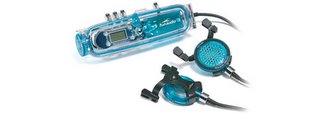 Recently, I noticed that a H2O Audio from San Diego has brought out a MP3 player housing that has a depth rating of 200 feet. I guess it was only a matter of time until a waterproof MP3 player housing became available for SCUBA divers. I do not know what the sound quality will be like, but I am guessing it will be fairly good.
There are some interesting possibilities that could come as offshoots having a waterproof MP3 player available on dives. For example one could design a guided tour of an interesting dive site with all kinds of information on the MP3 player.
There are the cynical amongst us who will treat the new device with scorn. Then there are the technophiles among us who will love the new device just because it is cool and new. To each his own I guess. If the MP3 player will help you have a more enjoyable, relaxing dive then I say party on.
On the other hand, there are people, like my daughter who cannot stand a single second of silence. Every second of the day is filled with some kind of sound. There is a certain comfort in listening to music when working out, running or doing some kind of physical work. The music tends to elevate your mood and help you “forget” about the “pain” of the workout.
 Recently, I noticed that a H2O Audio from San Diego has brought out a MP3 player housing that has a depth rating of 200 feet. I guess it was only a matter of time until a waterproof MP3 player housing became available for SCUBA divers. I do not know what the sound quality will be like, but I am guessing it will be fairly good.
There are some interesting possibilities that could come as offshoots having a waterproof MP3 player available on dives. For example one could design a guided tour of an interesting dive site with all kinds of information on the MP3 player.
There are the cynical amongst us who will treat the new device with scorn. Then there are the technophiles among us who will love the new device just because it is cool and new. To each his own I guess. If the MP3 player will help you have a more enjoyable, relaxing dive then I say party on.
Monday, November 07, 2005
Back in the classroom again
A while ago I wrote about continuing education and how important it is to keep learning, especially when it comes to SCUBA diving. Last weekend, I found myself in class again, this time learning to be an instructor to student instructors. As I wrote previously, I like learning new things and part of the reason why I signed up for the staff instructor course was to learn more and to refine my skills. It has often been said that to really learn something you need to teach it.
There is a great deal of material that is covered in the instructor development course and we are expected to have mastered the material way beyond what is necessary for the student instructors. This of course is obvious since we will have to teach the material sometime in the future. The last time I studied the material it was all new and exciting, yet overwhelming. This time the material is not quite so overwhelming, yet there is a great deal to cover. Believe it or not, we actually enjoy the physics, physiology and theory parts. The part that is least fun is doing presentations to a group of your peers who find great joy and pleasure in pulling apart your presentations. It is all in good fun though. The pressure makes us work harder and makes us better instructors.
An observation that one of my fellow students made was how different it is "to be on the other side of the table". By this he meant how different it felt to sit in on presentations and skill demonstrations and do the evaluating. On the one hand one tends to be very lenient because you know how stressful it is to do the skill demonstrations to a group of evaluators, but on the other hand I remember how tough my instructors were on me when I was doing the same thing (at least that is how it felt). The term "splitting hair" comes to mind when thinking back on some of the comments I heard about my presentations. However, the tough learning environment more than prepared me for the actual classroom environment where I had to deliver the material to a group of eager student divers.
There is a great deal of material that is covered in the instructor development course and we are expected to have mastered the material way beyond what is necessary for the student instructors. This of course is obvious since we will have to teach the material sometime in the future. The last time I studied the material it was all new and exciting, yet overwhelming. This time the material is not quite so overwhelming, yet there is a great deal to cover. Believe it or not, we actually enjoy the physics, physiology and theory parts. The part that is least fun is doing presentations to a group of your peers who find great joy and pleasure in pulling apart your presentations. It is all in good fun though. The pressure makes us work harder and makes us better instructors.
An observation that one of my fellow students made was how different it is "to be on the other side of the table". By this he meant how different it felt to sit in on presentations and skill demonstrations and do the evaluating. On the one hand one tends to be very lenient because you know how stressful it is to do the skill demonstrations to a group of evaluators, but on the other hand I remember how tough my instructors were on me when I was doing the same thing (at least that is how it felt). The term "splitting hair" comes to mind when thinking back on some of the comments I heard about my presentations. However, the tough learning environment more than prepared me for the actual classroom environment where I had to deliver the material to a group of eager student divers.
Subscribe to:
Posts (Atom)
